
Market technique (German: Markttechnik) is a trend-following trading approach that is particularly widespread in German-speaking countries, where it was popularised above all by the trader and author Michael Voigt. It is based on the Dow theory, which Charles Henry Dow developed in the late 19th century. The Dow theory is an important foundation not only for market technique: many other methods of technical analysis also draw on its principles.
How does market technique differ from classical chart analysis?
Market technique is one of the methods of technical analysis and forms the basis of classical chart analysis. Chart analysis works with price patterns and indicators and tries to forecast future developments on the basis of past prices. Market technique, by contrast, tries to put itself in the shoes of the individual market participants in order to anticipate future prices. It therefore uses no chart patterns or indicators at all – trading decisions are made on the 'naked' chart, based on price alone. The patterns of classical chart analysis can nevertheless be explained well with market technique. A head-and-shoulders formation, for example, is nothing more than a trend reversal in market-technique terms.
Market-technique traders always examine a chart with two questions in mind:
Where does movement arise?
Who will buy after me?
The answers lie at prominent points on the chart where market participants are usually forced to take certain actions. A good example of such a forced action is the stop. For risk-management reasons, most market participants have an initial stop in place somewhere, usually at a prominent high or low. When the stop price is reached, the order becomes a market order and is therefore executed in any case. This in turn can trigger sharp movements in the markets.
Trading with market technique
Trading with market technique is not about always being right. Ultimately, only the market is ever right, and at best you can make statements about future market developments with a certain probability – which applies just as much to every other method of analysis. The aim is therefore to develop a consistent trading style with reproducible results. This implies that there are technically correct trades – executed exactly according to the rules – that still end in a loss. These are known as technically correct losing trades. Accordingly, there are four types of trade:
- technically correct winning trade
- technically correct losing trade
- technically incorrect winning trade
- technically incorrect losing trade
The quality of a trade is therefore judged by whether it followed the rules, not by its result alone.
How does market technique work?
Trading with market technique is a trend-following approach, so the trend is the most important tool of the market-technique trader. When a trend counts as a trend, how it forms and when it is broken is a broad topic in its own right and is covered in detail in the article on trends.
Traders must try to put themselves in the position of other market participants, because a profit can only be realised if other participants subsequently enter the market in the same direction. Before opening a long position, a trader should therefore ask: who will buy after me? For a short position, the question is: who will sell after me?
This is why it is important to know where you are. Is the market in an uptrend or a downtrend? Are you currently looking at a movement or a correction?
To answer these questions, market technique describes trends using what is known as the point count.
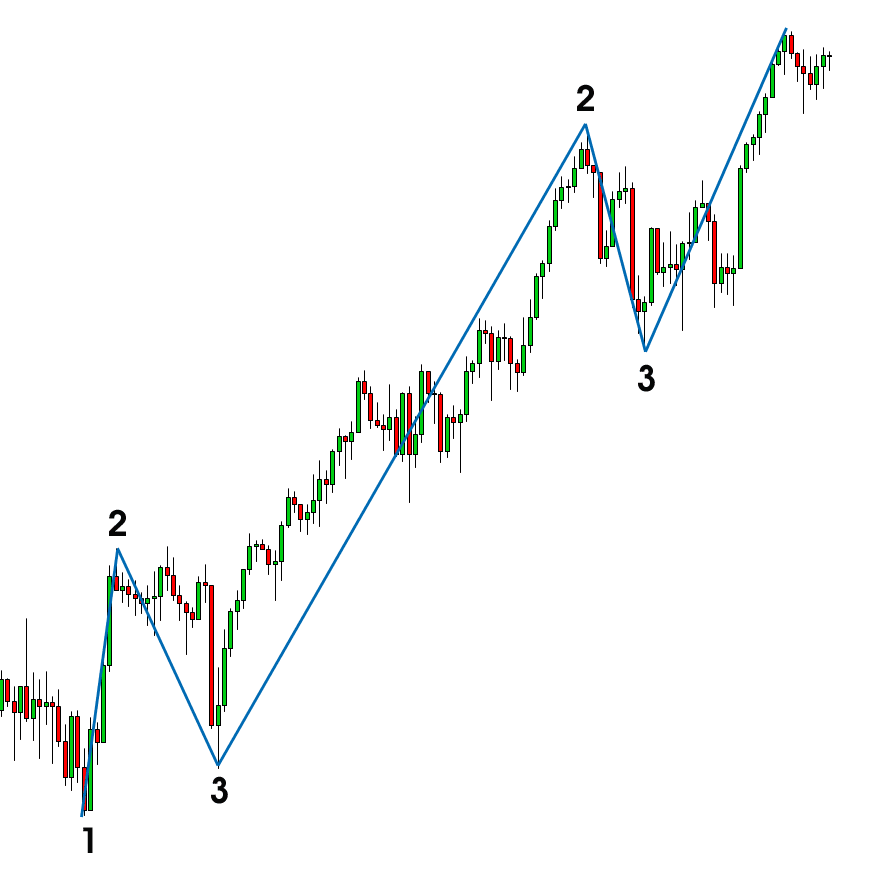
Point 1 marks the start of the first movement and is the first low.
Point 2 marks the end of the first movement and is the first high.
Point 3 marks the end of the first correction and is the second low, which must be higher than the first.
The count then continues from point 2: the next high, which lies above the previous point 2, becomes the new point 2.
The trend – in this case an uptrend – comes into being the first time buyers push the price above point 2. It remains intact as long as the price does not fall below the last point 3. In a downtrend, the count is mirrored: point 1 is a high, point 2 a low and point 3 a lower high.
Combining two timeframes
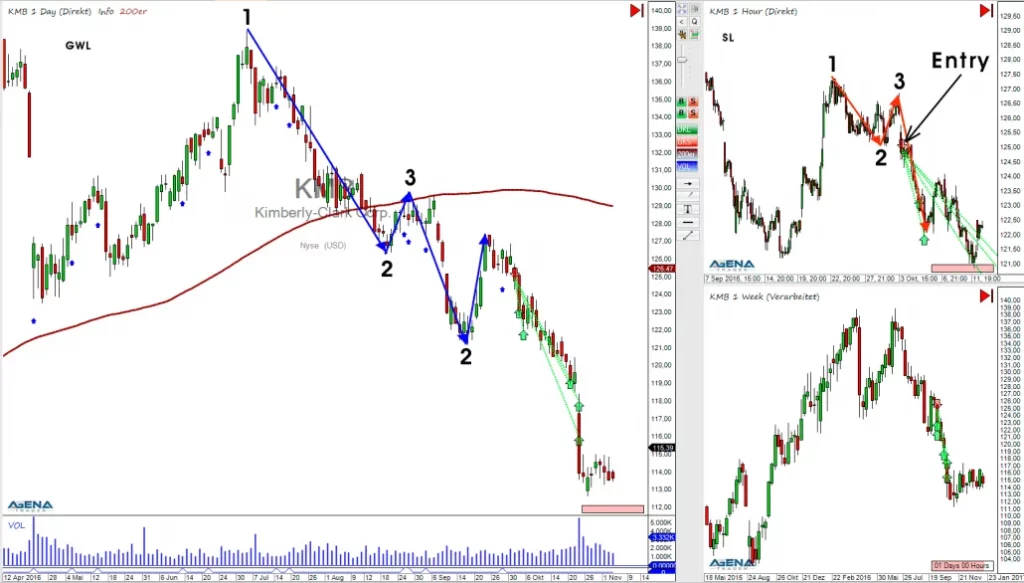
Market-technique traders usually combine two trend sizes. The higher-order trend size – the higher timeframe, or 'big picture' – sets the direction, while the lower-order trend size – the signal timeframe – determines the timing of the entry.
Higher timeframe: the 'where'
The higher timeframe is also called the 'where', because this is where you locate yourself in the market: are you in the movement or in the correction? As a trend follower, you always try to enter the market during a correction in order to achieve the best possible risk-reward ratio. That is why, at the 'where' level, you always wait for the correction. Charts that are already too far into the movement at the 'where' level are discarded straight away; only instruments that are in a correction make it onto the personal watchlist.
Signal timeframe: the 'how'
The signal timeframe is also called the 'how', because it is about how best to enter the higher-order trend. Within a correction, the signal timeframe shows signs that the higher-order trend is resuming – for example, a lower-order 1-2-3 or a reversal bar.
The following chart shows a good example of how the higher timeframe and the signal timeframe are combined:
Trading setups (entries) in market technique
Point 2 trade
In the P2 trade, you wait for a trend to form on the signal timeframe that confirms the higher-order trend of the higher timeframe.
Entry in the correction
With an entry in the correction, the trader waits until a trend has formed on the signal timeframe that confirms the higher-order trend, and then waits for this new signal-timeframe trend to correct in turn.
Fuzzy entry
The fuzzy entry gets its name because you do not wait for a signal on the signal timeframe. Instead, you enter directly on the higher timeframe once the correction has retraced almost 100% of the previous movement.
As this topic is complex, the setups are explained in detail in the article on trading setups in market technique.
Stops
Every professional trader has a stop-loss order in the market from the moment a position is opened, because this makes the risk taken calculable. Traders who do not use stops will find it very hard to trade profitably in the long run. Besides the initial stop, there are many other types of stop and stop strategies that traders need. They are covered in detail in the article on stop rules in market technique.